
The assessment
A strong business principle. A starting point for your own test.
Codie Sanchez’s “Don’t Become A Content Creator, Build A Content Business” argues for focused publishing, demonstrated expertise and a path to paid help. Those are useful principles. Her revenue claims, sponsorship ranges and channel rankings describe her account of her business; we have not independently audited them.
Our recommendation: run a small, measurable experiment around an existing skill and offer. You need enough evidence to decide whether the audience wants your help before investing in a larger product catalog.
What we would change
- Treat platform rankings as hypotheses. One creator’s event sales do not establish which channel will work for your buyers.
- Count the work. Organic distribution consumes research, production, follow-up and delivery time. Include those costs.
- Use your own baseline. Fixed engagement targets can hide differences in topic, format, audience and traffic source.
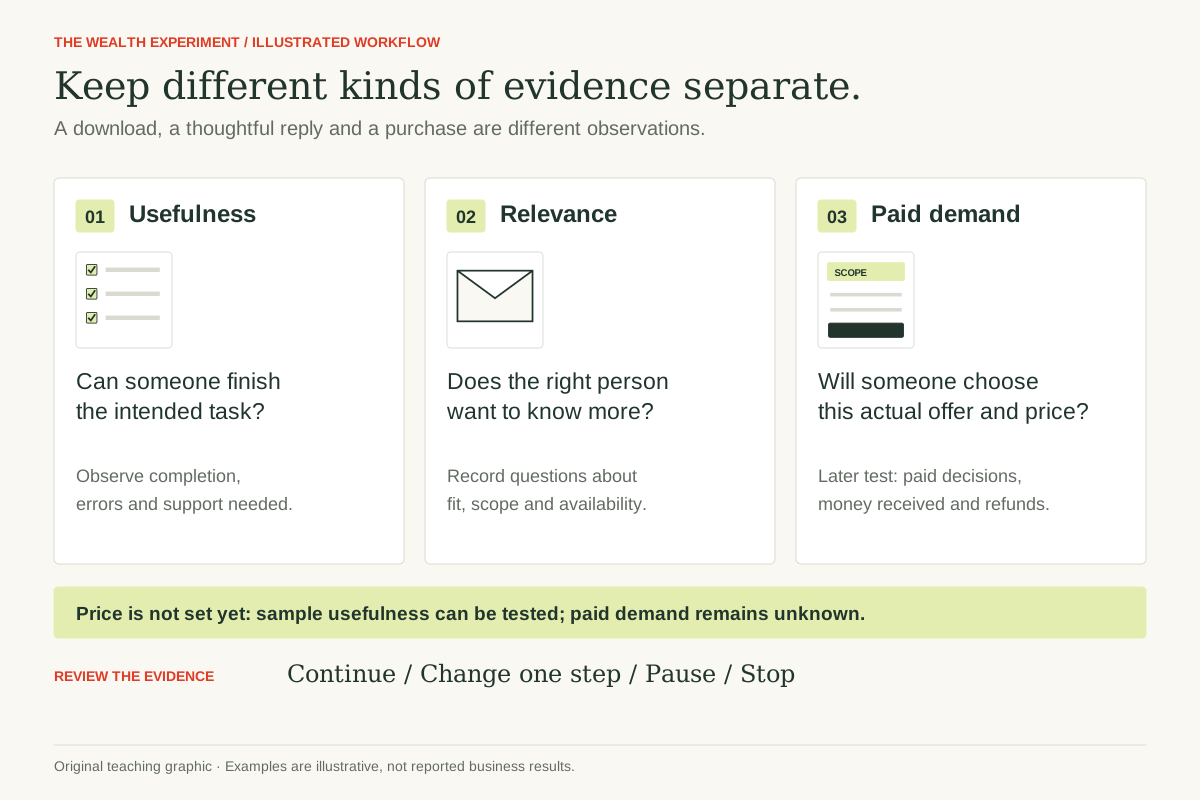
- Separate interest from paid demand. Downloads and compliments are useful signals. A paid decision answers a different question.
The six ideas in the video
A short, attributed summary of Sanchez’s framework. The exercises below are our own implementation plan.
- Channel · 0:15
- Focus on one platform before expanding.
- Credibility · 12:12
- Show work you have actually done.
- Category · 14:35
- Become recognizable for a clear subject and repeatable formats.
- Curate · 17:20
- Study relevant content and unanswered audience questions.
- Calibrate · 19:13
- Use response and viewing data to improve the work.
- Collect · 23:15
- Connect content with an email relationship and paid solutions.
These links jump to the relevant passages. Review based on the available video transcript; no claim is made about its private analytics or production process.
Choose a buyer and a problem you can demonstrate.
Write a sentence that makes the audience, task and result concrete: “I help [specific people] complete [specific task] so they can [useful result].” Test it against questions you have actually heard. If you can only name a broad topic such as “AI,” narrow the promise.
Practical AI for independent consultants
Audience: consultants who spend too much time turning client calls into follow-up work.
Promise: turn approved meeting notes into a checked recap, an action list and clear open questions.
First offer: a focused working session to build and review that workflow with the consultant.
This is an illustrative plan, with no claimed audience growth or sales results.
Pick the channel you can sustain
| Starting situation | Channel to test | First useful format |
|---|---|---|
| Your buyers are professionals discussing work problems. | An annotated example plus a short explanation. | |
| Your audience needs to see a process from start to finish. | YouTube | A complete screen-recorded tutorial. |
| Your value is easy to show visually. | Instagram or TikTok; choose one. | A demonstration with a visible outcome. |
These are starting hypotheses, not a ranking of earnings. For the consultant example, start with LinkedIn and add an email signup destination. After the first review, decide whether a deeper YouTube tutorial would answer a repeated question. Use the platform worksheet if your audience differs.
Finish this step with: one audience, one problem, one channel, one primary next action and a review date.
Build a small proof file before writing.
Choose one real task you can show. Capture its starting point, your process, the finished output and the checks you performed. Use your own material or examples you have permission to publish. A fictional teaching example is fine when it is labeled.
- Starting point: an approved, anonymized set of meeting notes.
- Process: the instructions used to separate decisions, owners and unresolved questions.
- Result: the reviewed follow-up, with corrections visible.
- Limit: what still needs the client’s judgment or approval.
If you report time saved, record setup, drafting and checking time as well as the original task time. One successful attempt is a case note; repeat the task before claiming consistent savings. The Creator Studio helps organize work samples.
A useful role for AI
Ask it to organize your approved notes, identify unanswered questions and suggest ways to explain a real result. Check its draft against the evidence and rewrite it in your own voice. Keep a visible list of claims you cannot yet support. See the human-proof creator workflow.
Connect the next step before publishing.
Make every stage solve the same problem at a different level of help. A reader should understand why the next step belongs.
- Public example
Show how a meeting recap can accidentally turn an idea into a commitment. Demonstrate the correction.
- Useful resource
Offer a worksheet for checking decisions, owners, dates and open questions. Make the download easy to find.
- Permission-based follow-up
Invite readers to subscribe for related examples. Say what they will receive, deliver the resource you promised and provide an unsubscribe option.
- One paid outcome
Offer help building the same process for their work. State the deliverable, scope, price, timing, required inputs and boundaries.
For this example, AI Teachers’ existing AI Working Session is a relevant implementation route. It is part of our wider business. Check its current scope and booking details there. You can also use this method with an offer you already deliver.
Test the page, signup, confirmation, resource delivery and booking or payment path yourself before directing people to it. Keep test activity separate from real demand. Adding this guide does not set up a sales funnel or verify email delivery for you.
Keep the first offer small enough to deliver well. Expand only after people choose to pay and the delivery effort makes sense.
Research ten relevant examples and five real questions.
Choose ten examples from at least three independent creators serving similar people. Include some ordinary posts and weak performers; a list of viral hits alone hides the work that did not connect. Read public questions and, when appropriate, ask your own audience what is difficult.
Record the source URL, date, audience problem, opening approach, demonstrated evidence, next action and a question the post leaves unanswered. Paraphrase patterns in your notes. Develop your own wording and examples.
Do not reject a relevant example just because it has fewer than a million views. A small specialist audience may contain more suitable buyers than a broad entertainment audience. Public view counts cannot tell you what sold.
Finish this step with: five audience questions in the Research Lab, and one that you can answer with your proof file this week. Its notes stay in your browser, so export a backup.
Turn one real result into a weekly series.
Use three complementary posts each week: a demonstration, a practical explanation and a question-led follow-up. Reuse the underlying evidence while giving each post a distinct job. The following topics are original examples for the consultant workflow.
| Week | Show the work | Teach the method | Answer the next question |
|---|---|---|---|
| 1 | A meeting note that needs clarification. | A four-part recap checklist. | What should never become an assigned task? |
| 2 | How you caught an invented deadline. | How to preserve unknowns in a draft. | What can you safely use as a practice input? |
| 3 | The corrections needed in a second test. | How to measure review time. | When is a template enough? |
| 4 | Your actual test results and limitations. | Your revised process, with reasons. | Who would benefit from a working session? |
Keep the invitation relevant: download the checklist on a teaching post; explore a working session on an implementation post. Do not imply that every reader needs to buy.
A manageable weekly routine
Try a three-hour content budget: 30 minutes researching questions, 45 capturing a real example, 60 drafting and reviewing three posts, 30 responding to useful conversations, and 15 recording what happened. This is a planning estimate; track actual time and reduce the schedule if needed. Delivery time for paying clients is additional.
Publish where your chosen audience already spends time. Reply thoughtfully to relevant questions and participate in communities that allow your contribution. Posting on a website alone does not distribute the work.
Measure the whole path, including the money and effort.
Record each post’s URL, publication date, topic, format, next action and production time. Review comparable posts after the same elapsed time, such as seven days. Keep different platforms and formats separate.
| Stage | Record | What it helps you decide |
|---|---|---|
| Discovery | Impressions or reach; format; source. | Did relevant people have a chance to see it? |
| Usefulness | Watch behavior, substantive replies, saves or shares, as available. | Did the explanation help or prompt a real question? |
| Next action | Resource-page visits, downloads and confirmed signups, separately. | Is the invitation clear and is the path working? |
| Demand | Qualified inquiries, paid decisions and money received, separately. | Does anyone want help implementing this? |
| Economics | Refunds, fees, direct expenses, content hours and delivery hours. | Can you keep providing it at this scope and price? |
Define a qualified inquiry before the test: for example, a consultant with a specific recurring task who asks about scope, price or booking. A friendly comment alone does not qualify.
Read the numbers in context
YouTube’s guidance says half of channels and videos have an impressions click-through rate between 2% and 10%, with substantial variation. Compare your similar videos and traffic sources over time. A falling CTR can accompany wider distribution.
Apple Mail Privacy Protection can inflate email opens. Use confirmed subscriptions, replies, bot-filtered clicks where available and completed actions alongside opens. Automated scanners can also inflate clicks, so a click is not proof of buyer intent.
Use distinct campaign links for each distribution channel, and ask new buyers how they found you. Link tags help only if your analytics records them. Cross-device journeys and privacy settings leave attribution gaps; label uncertain sources.
- Few relevant people reached: check topic and distribution before judging the offer.
- Readers engage but do not visit: test a clearer, more relevant invitation.
- Visitors arrive but do not sign up: check the resource promise and form.
- Inquiries arrive but nobody buys: record objections about fit, scope, timing and price.
- People buy but delivery takes too long: improve the process or change the scope.
A 30-day test is directional evidence. A handful of posts or visitors cannot establish that a channel or business model will never work. Change one major variable at a time so the next test teaches you something.
Put it into practice
Your first 30 days
Build the path
Choose the audience and offer. Gather questions and proof. Check the resource and next-step experience. Publish the first three examples when that path works.
Keep: a one-page brief and baseline.Learn from the first response
Publish three related posts. Answer questions. Record source links, hours and real actions. Check the first week’s posts at a consistent seven-day age.
Keep: a list of friction and questions.Improve one weak step
Choose one change: the topic, explanation, invitation or page. Publish three more posts. Keep the rest of the path steady where possible.
Keep: the change and the reason.Make a business decision
Publish the final three examples. Review sufficiently aged posts, inquiries, paid decisions, costs and delivery effort. Mark younger posts as preliminary.
Choose: continue, change, pause or stop.If preparing the resource takes longer, publish fewer posts. The goal is a coherent path and usable evidence. Schedule a later seven-day review for posts too recent to compare on day 30.
Your working document
Make the plan yours.
The editable workbook includes a positioning brief, proof checklist, research log, 12-post tracker, funnel review and a decision page. Download it, fill it in locally and keep the same document through the experiment.
Free download, no signup required. Your browser’s print dialog can also save this guide as a PDF.
Use the tools already here
- Research Lab: audience questions and experiment notes.
- First 10 Posts: detailed practice when you need help making the work.
- Creator Studio: work samples and a relevant pitch.
- Email audience guide: a useful reason to stay in touch.
- Be an Influencer newsletter: subscribe for further creator resources.
Put the framework to work
Turn one useful answer into a pocket product
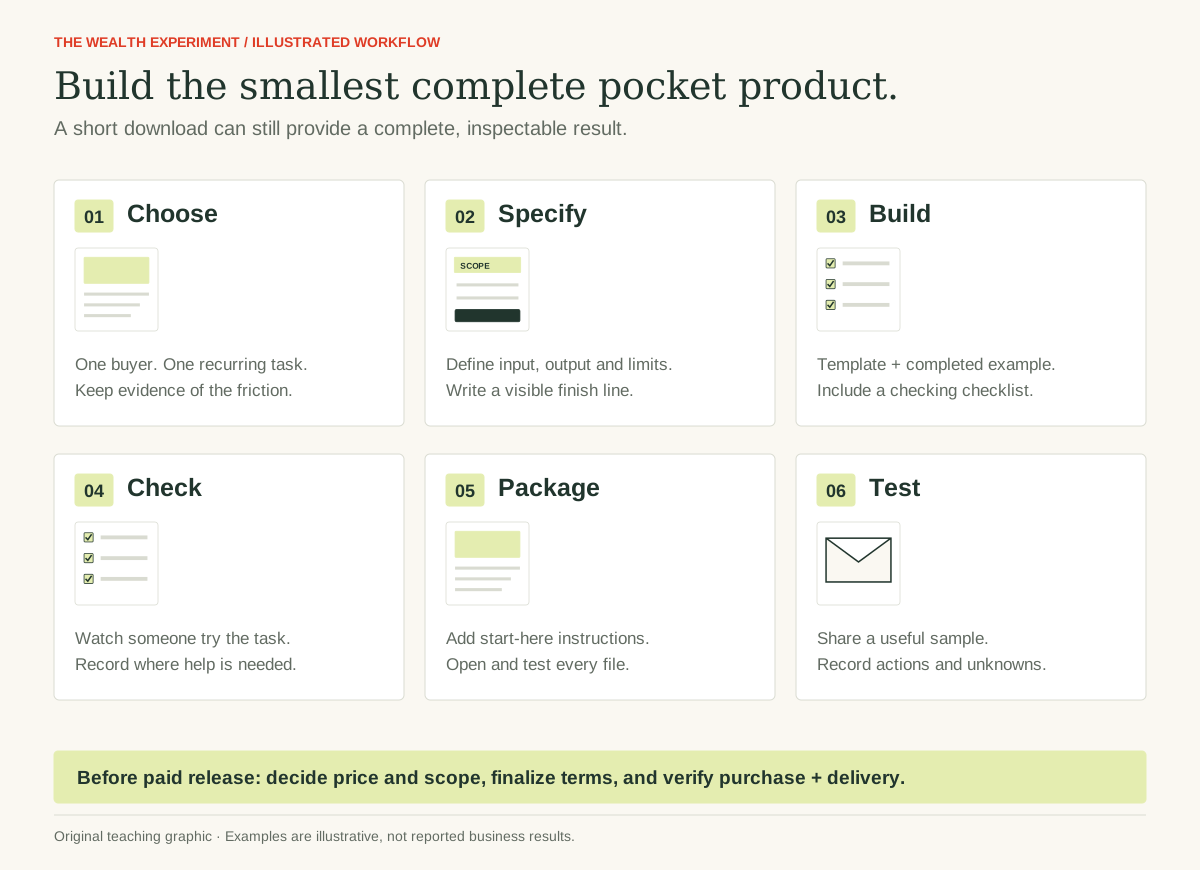
A pocket product is a small resource for one recurring task: a worked example, an editable template and clear instructions. Start with a question your audience already asks. Test whether someone can use your answer before expanding it into a bigger product.
Two practical kits to explore
The Content-to-Client Kit connects audience, proof, twelve content briefs and permission-based follow-up to one offer. The Pocket Product Launch Kit helps you scope, build and test a narrow digital resource.
Both have free three-page samples. Pricing is to follow; paid sales for these two kits are not active.
- Download the Content-to-Client sample (PDF)
- Download the Pocket Product Launch sample (PDF)
- Follow the 30-day Wealth Experiment plan
- Apply the method to recurring client questions
Sources and editorial notes
Reviewed November 15, 2026. This independent guide is not affiliated with or endorsed by Codie Sanchez. Her six-part framework is credited above. Our schedules, examples, recommendations and workbook are original teaching material, not reported business results.
- Codie Sanchez: Don’t Become A Content Creator, Build A Content Business — published July 21, 2026. Transcript reviewed; channel revenue and sales claims are self-reported.
- YouTube: Impressions and click-through-rate FAQs.
- Mailchimp: Apple Mail Privacy Protection FAQs.
- Mailchimp: Bot activity and filtering.